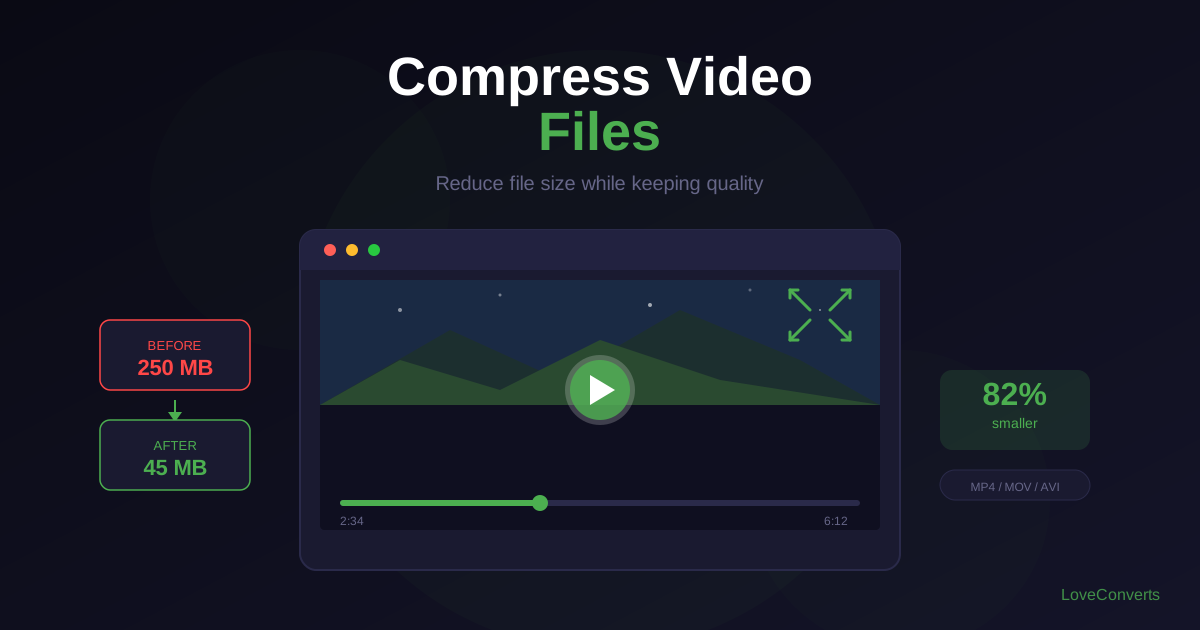
How to Compress Video Files Online for Free
You recorded a 3-minute video on your phone and it is 500MB. You cannot email it. WhatsApp rejects it. Uploading to Google Drive takes forever. You need to compress the video online to make it manageable, and you should not have to install software to do it.
This guide explains how video compression works, what settings to use, and how much you can realistically shrink a video.
How to Compress a Video File Online
The process is simple:
- Go to the video compressor on LoveConverts.
- Upload your video. Drag and drop or click to browse. Supports MP4, MOV, AVI, WEBM, and MKV.
- Choose a compression level. Options range from light (smallest reduction, best quality) to extreme (biggest reduction, some quality loss).
- Wait for processing. Video compression takes longer than image compression because there is much more data. A 100MB video typically takes 30-60 seconds.
- Download the compressed video.
Your original file is not modified, and nothing is stored on our servers after you download.
Understanding Video Compression Settings
Video compression works differently from image compression. Instead of a simple quality slider, there are several factors that affect the output:
- CRF (Constant Rate Factor): This is the quality control for video. Lower numbers mean higher quality and larger files. A CRF of 23 looks great. A CRF of 30 is noticeably softer but much smaller. Our "medium" preset uses a CRF that balances size and quality well.
- Resolution: A 4K video downscaled to 1080p will be dramatically smaller. If you are sharing via messaging or email, 1080p or even 720p is more than enough.
- Bitrate: The amount of data per second of video. Higher bitrate means better quality and larger files. Compression works by reducing the bitrate.
How Much Can You Actually Compress a Video?
This depends heavily on the source material:
- Phone recordings (iPhone, Samsung): These are often recorded at very high bitrates. Expect 50-80% reduction. A 200MB clip can easily drop to 40-80MB.
- Screen recordings: Typically compress very well (70-90% reduction) because most frames are similar. A 300MB screen recording might compress to 30MB.
- Already-compressed videos: If the video came from WhatsApp, Instagram, or another platform that already compressed it, there is less room. Expect 20-40% reduction.
- Drone or GoPro footage: High-bitrate action footage. Expect 50-70% reduction.
The Resolution Trick That Saves the Most Space
Here is something most compression guides do not mention: reducing resolution saves far more space than increasing compression at the same resolution.
A 4K video (3840x2160) has 4x the pixels of a 1080p video (1920x1080). Compressing the 4K video to "high" quality might reduce it by 60%. But simply downscaling to 1080p at medium quality can reduce it by 85%+ while looking perfectly fine on a phone screen or in an email.
Unless you know the video will be viewed on a 4K monitor at full screen, downscaling to 1080p before sharing is the single most effective optimization you can make.
Common Use Cases and Recommended Settings
- Email attachment: Compress to medium quality. Most email providers cap attachments at 25MB, so you may also need to reduce resolution.
- WhatsApp/Telegram: WhatsApp compresses videos itself during sending. Compress to medium beforehand to avoid double compression.
- Website background video: Compress aggressively. Background videos should be under 5MB if possible. Use low quality and reduce resolution to 720p.
- Archival: Use light compression or none. Storage is cheap; losing quality is permanent.
After compressing, if you need to extract a still frame from the video for a thumbnail, use the crop tool or take a screenshot and compress it with the image compressor.