How to Convert SVG to PNG Free Online
You have an SVG logo or icon and need a PNG version for a platform that does not accept vector files. Or you need a rasterized version at a specific pixel size. Converting SVG to PNG is straightforward, but there is one thing most people get wrong: the output resolution.
This guide explains how to get it right so your converted PNGs look sharp at any size.
Why Convert SVG to PNG?
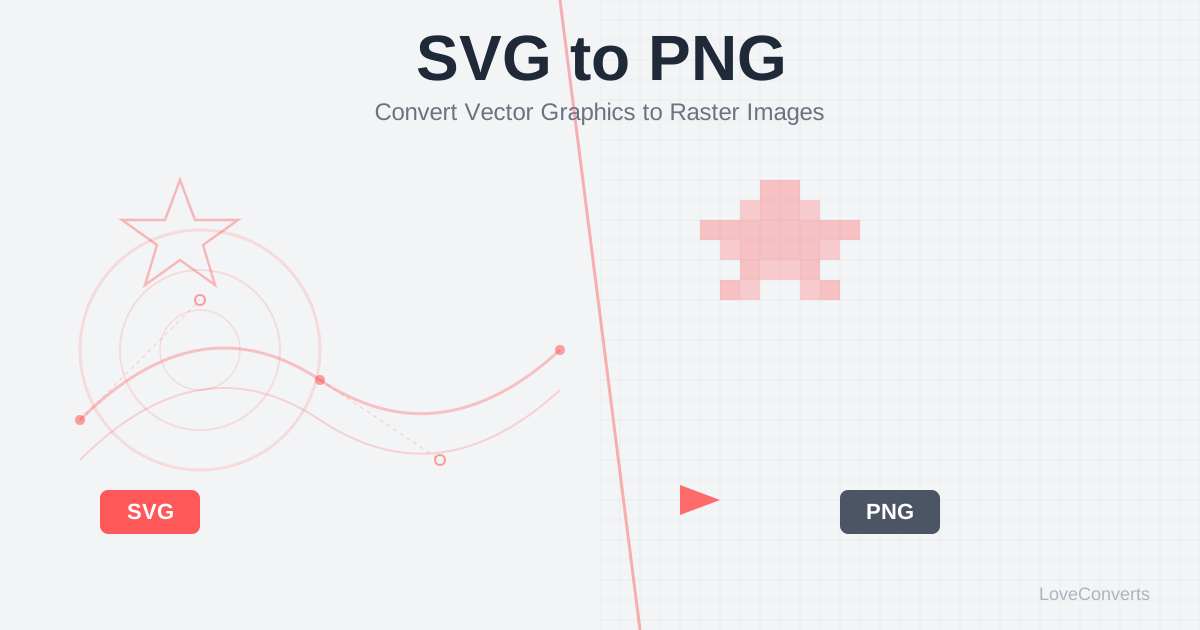
SVG (Scalable Vector Graphics) is the ideal format for logos, icons, and simple illustrations. It scales to any size without losing quality because it describes shapes mathematically rather than as pixels. However, many places do not accept SVG:
- Social media platforms (Instagram, Facebook, Twitter) reject SVG uploads
- Email signatures typically need PNG or JPG
- Some website builders and CMS platforms only accept raster images
- Print shops often want PNG or TIFF, not SVG
- Presentation software sometimes renders SVGs inconsistently
PNG is the best raster format for SVG conversion because it supports transparency and uses lossless compression, preserving the crisp edges that make vector graphics look good.
How to Convert SVG to PNG Online
- Open the image converter on LoveConverts.
- Upload your SVG file.
- Select PNG as the output format.
- Click Convert and download the result.
The converter renders the SVG at its native dimensions by default. If you need a specific size, resize the PNG after conversion.
Getting the Right Resolution (This Is Where Most People Go Wrong)
SVGs have no fixed pixel dimensions. They scale infinitely. When you convert to PNG, the tool must pick a specific pixel size. If you convert a logo SVG to a 100x100 PNG but then display it at 400x400 on a website, it will look blurry because you are stretching 100 pixels across 400.
The fix: convert at 2x your intended display size. This ensures the PNG looks sharp on regular screens and retina/high-DPI displays.
- Favicon: Convert to 512x512 (the largest favicon size needed)
- Social media profile picture: Convert to 800x800
- Website logo: Convert to 2x your display size (e.g., logo displays at 200px wide, convert to 400px wide)
- Print: Calculate from DPI. For a 2-inch logo at 300 DPI, you need 600x600 pixels
SVG to PNG vs SVG to JPG: Which to Choose
Always choose PNG unless you have a specific reason to use JPG. Here is why:
- PNG keeps transparency. Most SVG logos and icons have transparent backgrounds. JPG does not support transparency and fills transparent areas with white.
- PNG is lossless. The sharp edges in vector graphics look clean in PNG but can get fuzzy artifacts in JPG.
- File size is similar for simple graphics. PNG and JPG produce comparable file sizes for logos and icons. PNG only gets much larger for photographic content.
The one exception: if you need the smallest possible file and do not need transparency, JPG at quality 90 will give you a slightly smaller file. But for logos and icons, the difference is usually just a few KB.
Batch Converting Multiple SVGs
If you have a set of SVG icons that all need PNG versions, upload them all at once. The converter handles up to 30 files in a single batch. You get a ZIP download with all the PNG files.
After converting, you might want to compress the PNGs to reduce file sizes for web use. PNG compression is lossless, so the images stay pixel-perfect but take up less space.
When to Keep SVG Instead of Converting
If your target platform supports SVG, do not convert. SVG files are almost always smaller than their PNG equivalents and scale perfectly to any screen size. Modern web browsers, most design tools, and many CMS platforms support SVG natively. Only convert when the destination specifically requires a raster format.