How to Reduce Image Size Without Losing Quality
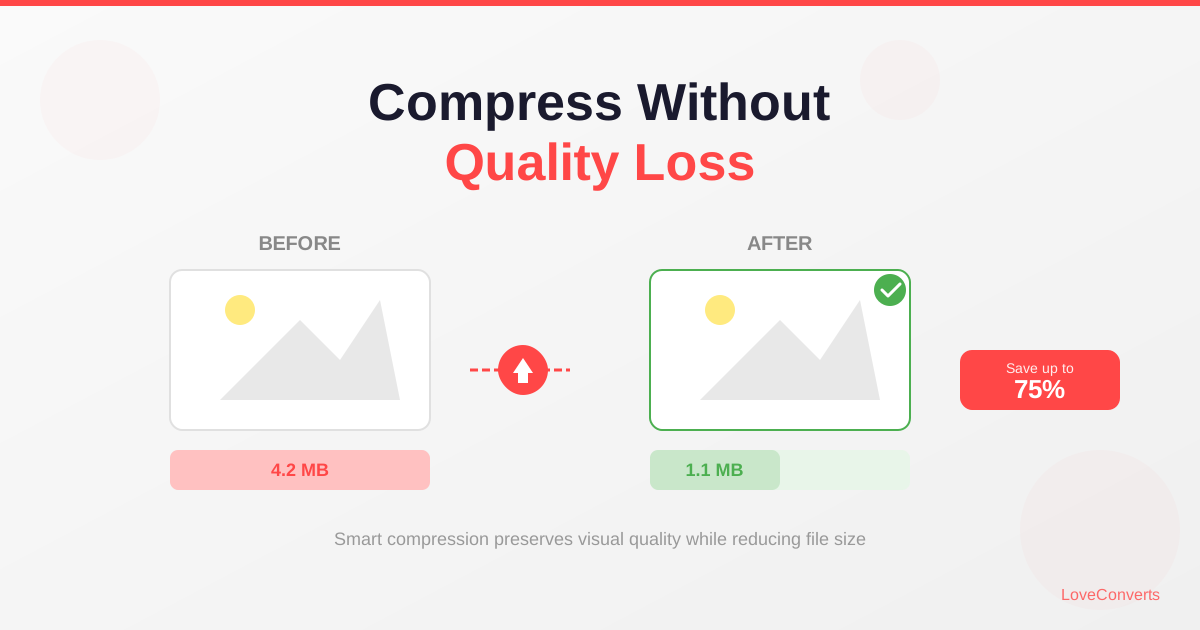
You need to reduce image size without losing quality, but every time you compress, the result looks worse. The key insight most people miss is that file size and image dimensions are two different things. You can dramatically cut the number of bytes in a file without changing a single visible pixel, if you use the right settings.
This guide explains how compression actually works, which settings produce the best results, and when switching formats gives you a bigger reduction than adjusting quality alone.
File Size vs Image Dimensions
Before optimizing, it helps to understand what "image size" actually means, because it refers to two completely different things:
- File size (measured in KB or MB): How much space the file takes on disk. This is what you want to reduce for faster uploads, email attachments, and web page loading.
- Dimensions (measured in pixels): The width and height of the image. A 3000x2000 pixel image has more detail than a 1000x667 image. Reducing dimensions makes the image physically smaller.
Compression reduces file size without touching the dimensions. Resizing reduces dimensions (and therefore file size too). For the biggest reduction, do both: resize to the actual size you need, then compress.
The 80% Quality Rule
JPG and WebP compression at quality 80% removes data that is invisible to the human eye under normal viewing conditions. This includes subtle variations in color that your monitor may not even be capable of displaying, and fine noise patterns from the camera sensor.
Here is what happens at different quality levels:
- Quality 95-100%: Virtually no compression. File is nearly as large as the original. Only needed for professional print work.
- Quality 85-90%: Very slight compression. Impossible to distinguish from original without pixel-level comparison. Good for high-quality archiving.
- Quality 75-85%: The optimal range. Files are 50-70% smaller. Quality loss is invisible at normal viewing sizes. This is what you should use for most purposes.
- Quality 60-74%: Noticeable softness in detailed areas. Fine for thumbnails and small display sizes.
- Below 60%: Obvious compression artifacts. Blocky patterns, color banding, and lost detail.
Upload an image to the compress tool, set quality to 80%, and compare the result with the original. In most cases, you will not be able to tell which is which.
Choosing the Right Format
The format you use affects file size as much as the quality setting. Different formats use different compression algorithms, and some are simply more efficient than others.
WebP beats JPG. At the same visual quality, WebP files are typically 25-35% smaller than JPG. If your use case supports WebP (all modern browsers do), converting from JPG to WebP is one of the easiest ways to cut file size.
AVIF beats WebP. The newest mainstream format, AVIF, produces files 30-50% smaller than JPG at equivalent quality. Browser support is strong in 2026, though not yet as universal as WebP.
PNG is larger but lossless. PNG compression does not remove any data, so there is zero quality loss. But PNG files are 3-10x larger than JPG. Use PNG only when you need transparency or pixel-perfect accuracy (screenshots, logos, diagrams).
Resize Before You Compress
If your image is a 4000x3000 photo from a phone camera but you only need it for a blog post displayed at 800px wide, you are carrying 15x more pixels than necessary. Resizing to 1200x900 (a comfortable size for web display with retina support) removes the majority of the file size before compression even enters the picture.
A typical workflow for web images:
- Resize to 1200-1600px on the long side using the image resizer (unless you need larger for full-screen display)
- Compress to quality 80% using the compressor
- Optionally convert to WebP for an additional 25-35% reduction
Following these three steps, a 5MB phone photo typically ends up at 80-150KB, a reduction of 95% or more, with no visible quality loss at the display size.
Batch Reducing Multiple Images
If you have a batch of images to optimize (common when preparing photos for a website or presentation), processing them individually is slow. The LoveConverts compressor accepts up to 30 files at once. Upload the batch, set your quality level, and download all compressed images as a ZIP file.
For ongoing work, establish a consistent workflow. Every image goes through the same process: resize to target dimensions, compress at 80%, convert to WebP if for web use. Consistency prevents the common situation where some pages load fast and others crawl because someone uploaded an uncompressed 8MB photo.
How to Verify Quality After Compression
After compressing, open both the original and compressed images side by side. View them at 100% zoom (actual pixels) and look for these signs of over-compression:
- Blocking: Visible square grid patterns, especially in smooth gradients like sky
- Ringing: Halos or fringes around high-contrast edges
- Color banding: Smooth gradients turning into visible steps of color
- Mosquito noise: Shimmering artifacts around text and sharp edges
If you see any of these, increase the quality setting by 5-10% and try again. At quality 80%, these artifacts are rarely visible. They typically only appear at quality 65% or below.